Showing posts with label Blackberries. Show all posts

Saturday, July 22, 2017

Blackberries and Pie Again
Blackberries and Pie Again

This is a new version of what I wrote in my blog during another summer several years ago when it was blackberry season.  The first line below applied then and today.

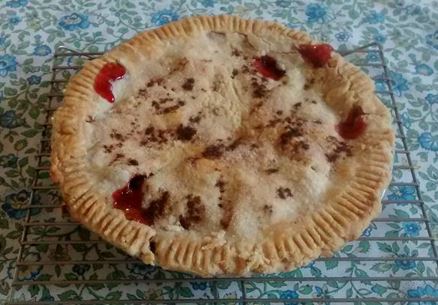
I picked wild blackberries this morning and made some of them into a pie. It’s the beginning of the wild blackberry season in Madison.

Pie is a wonderful part of Americana. For me, it is the all American dessert. When it’s good, it’s very, very good, and when it’s bad, it’s horrid. I make very good pie. Many grocery stores make very bad pie. Grocery store pies often have mass produced crusts that are not flaky and taste like straw. Since I believe that pies are more than fillings stuffed between soft cement crusts, I prefer to eat pies that I make.

My great aunt Lina used to make pie crust that was like hard cement; she mixed it too much. Needless to say, she didn’t teach me how to make pies. My mother did give a few pointers, although I actually never saw her make a pie. She gave me an important bit of advice, which I have followed with good results. She said not to mix the dough very much. My pie crust is flaky and delicious. Thanks, Mother.

My blackberry pie recipe is derived from my big fat falling-apart Better Homes & Gardens New Cook Book, 1953 edition, for the crust, and adapted from a pie recipe on the box of Minute Tapioca, for the filling. The tapioca box doesn’t say how to make blackberry pie. It says how to make blueberry pie. Close enough. Since my cooking interest is in how to cook for one or two people, I cut the tapioca box recipe in half to make an eight-inch pie. If your kitchen does not have an eight-inch pie plate, you are likely to find one at a thrift store. Ditto for rolling pin.

Blackberry Pie – one eight-inch pie
Preheat oven to 400 degrees.

2 cups fresh blackberries
½ cup sugar
2 tablespoons quick cooking tapioca

Mix fruit, tapioca and sugar in bowl. Let stand 15 minutes. Make an 8-inch pie crust while waiting. Use your recipe or the one here.

1 ½ cups all purpose flour (of course I think it is bad for us, but it makes good pie)
½ teaspoon salt
½ cup lard, butter or shortening; I use lard (I’ll have more to say about this later)
4 tablespoons cold water (approximately)

Stir together the flour and salt. Cut in the lard or other fat until pieces are the size of peas.  Sprinkle water, a tablespoon at a time, over the mixture. Gently mix with fork until all is moistened. Don’t mix too much. Form the mixture into a ball. Divide it in half. Flatten the first half slightly and roll it on a lightly floured pastry cloth or floured sheet of waxed paper. Roll the dough with light strokes, from center of the piece to the edges, so it makes a circle of dough about the size of the pie plate. Put the dough into the pie dish. I fold half over the other half, pick it up carefully and put it in the dish, and then unfold it.

Put berry/tapioca mixture into the pie plate on the bottom crust. Dot it with butter.  Moisten the peripheral edges of the bottom crust with water, all the way around. Roll the second half of the crust dough into a circle that will fit onto the pie plate. Seal the edges with fork or Fluting. I use a fork. Consult your cookbook to flute edges. Cut vent holes in crust with fork.  Bake the pie in a pre-heated oven at 400 degrees, for 45 or more minutes, until it is brown and done. If juices escape and drip onto your oven floor during baking, resign yourself. It’s still a good pie. You can put a cookie sheet under the pie dish to catch juices. I baked my pie in the toaster oven, so that option was not available.


Comment about fat:  fat is a big issue these days, but pie requires it. I think lard makes wonderful crust, but good lard is hard to find. The lard in the big box grocery stores is partly hydrogenated and not recommended unless you don’t care about your health. I can buy pasture raised, minimally processed local lard, frozen, at the Willy Street Coop (Madison and Middleton), which is the only place I have seen it. Lard contains cholesterol.  I don’t believe that cholesterol is bad for people, but that is another story. If good lard is not available, I recommend butter. A third choice is vegetable shortening, preferably not hydrogenated, although it does not lend flavor to the crust the way lard and butter do.  Purchased pie crust is available in grocery stores, and it is all right, but in my opinion, it lacks the character of homemade crust. I don’t know what extra ingredients are in it, such as chemicals and flavorings.

Thursday, July 26, 2012

Blackberries and Pie

I picked wild blackberries this morning and made some of them into a pie.

The chronology was: (1) pick berries amid bushes and brambles and in very high humidity; (2) Come home and wash poison ivy contamination off hands and arms; (3) wash poison ivy contaminated jeans, shirt and socks; (4) make pie. I wasn’t counting on the poison ivy, although I know that it grows well in berry patches. I was standing in it when I noticed that it was there. Oh, well.

Unfortunately, the drought has done a lot of damage to our local wild berries. A couple of weeks ago, in my favorite berry patch, I saw that a lot of blackberry bushes were dying with baby berries on them, and the berries looked like forlorn dried up raisins. When I went back to that spot today, about half the bushes were dead. However, some bushes have survived, and they are giving us small but good berries. Large blackberries are more desirable, but small ones are better than no berries. They produce more seeds per cubic inch of berry (to get caught in the food traps in our mouths), but we can’t have everything.

Pie is a wonderful part of Americana. For me, it is the all American dessert. When it’s good, it’s very, very good, and when it’s bad, it’s horrid. I make very good pie. Many grocery stores make very bad pie. Grocery store pies often have mass produced crusts that are not flaky and taste like straw. Since I believe that pies are more than fillings stuffed between soft cement crusts, I prefer to eat pies that I make.

My great aunt Lina used to make pie crust that was like hard cement; she mixed it too much. Needless to say, she didn’t teach me how to make pies. My mother did give a few pointers, although I actually never saw her make a pie. She gave me an important bit of advice, which I have followed with good results. She said not to mix the dough very much. My pie crust is flaky and delicious. Thanks, Mother.

My blackberry pie recipe is derived from my big fat falling-apart Better Homes & Gardens New Cook Book, 1953 edition, for the crust, and adapted a pie recipe on the box of Minute Tapioca, for the filling. The tapioca box doesn’t say how to make blackberry pie. It says how to make blueberry pie. Close enough. Since my cooking interest is in how to cook for one or two people, I cut the tapioca box recipe in half to make an eight-inch pie. If your kitchen does not have an eight-inch pie plate, you are likely to find one at a thrift store. Ditto for rolling pin.

Blackberry Pie – one eight-inch pie

2 cups fresh blackberries
½ cup sugar
2 tablespoons quick cooking tapioca)

Mix fruit, tapioca and sugar in bowl. Let stand 15 minutes. Make pie crust while waiting.

1 ½ cups all purpose flour (of course I think it is bad for us, but it makes good pie)
½ teaspoon salt
½ cup lard, butter or shortening; I use lard (I’ll have more to say about this later)
4 tablespoons cold water (about)

Stir together the flour and salt. Cut in the lard or other fat until pieces are the size of peas.  Sprinkle water, a tablespoon at a time, over the mixture. Gently mix with fork until all is moistened. Don’t mix too much. Form the mixture into a ball. Divide it in half. Flatten the first half slightly and roll it on a lightly floured pastry cloth or floured sheet of waxed paper. Roll the dough with light strokes, from center of the piece to the edges, so it makes a circle of dough about the size of the pie plate. Put the dough into the pie dish. I fold half over the other half, pick it up carefully and put it in the dish, and then unfold it.

Put berry/tapioca mixture into the pie plate on the bottom crust. Dot it with butter.  Moisten the peripheral edges of the bottom crust with water, all the way around. Roll the second half of the crust dough into a circle that will fit onto the pie plate. Seal the edges with fork or Fluting. I use a fork. Consult your cookbook to flute edges. Cut vent holes in crust with fork.  Bake the pie in a pre-heated oven at 400 degrees, for 45 or more minutes, until it is brown and done. If juices escape and drip onto your oven floor during baking, resign yourself. It’s still a good pie. You can put a cookie sheet under the pie dish to catch juices. I baked my pie in the toaster oven, so that option was not available.

Comment about fat:  fat is a big issue these days, but pie requires it. I think lard makes wonderful crust, but good lard is hard to find. The lard in the big box grocery stores is partly hydrogenated and not recommended unless you don’t care about your health. I can buy pasture raised, minimally processed local lard, frozen, at the Willy Street Coop (Madison and Middleton), which is the only place I have seen it. Lard contains cholesterol.  I don’t believe that cholesterol is bad for people, but that is another story. If good lard is not available, I recommend butter. A third choice is vegetable shortening, preferably not hydrogenated, although it does not lend flavor to the crust the way lard and butter do.  Purchased pie crust is available in grocery stores, and it is all right, but in my opinion, it lacks the character of home made crust. I don’t know what extra ingredients are in it, such as chemicals and flavorings.

Friday, August 6, 2010

Blackberries Galore

It's still blackberry picking time in Madison. This morning I found some along the Verona link of the Ice Age Trail, accessible from county road PD. It would have been wonderful if the mosquitoes hadn't emailed all their relatives to say that I would be coming. The only person who wasn't complaining about the bugs was the dog that came along with the other lady who was picking. I finally decided that I could have brought home many more berries, but the mosquitoes became a major obstacle. Alas. It's not easy being part of their food chain.

I really have found enough for one season anyway. I have made a blackberry pie, blackberry ice cream topping, blackberry cobbler, and put some blackberries in the freezer. I regret that our fair city leveled a very promising blackberry patch in Elver Park near my home. It cut my harvest in half. I don't understand why the city fathers didn't wait until after the berries were finished. Fortunately, there are other blackberry patches. And there will be more in a patch at an undisclosed location on Washington Island later in August, when I expect to be there.

The blackberry cobbler that I made is my adaptation from the Cherry Cobbler that I reported on, from the Prairie Farmer WLS Cook Book of 1941. They could have thought of blackberries while they were working on cherries, but they didn't. So here is my version. I like it a lot in spite of the seeds.

Blackberry Cobbler for  2

1 - 1 1/4 cup (approx.) fresh blackberries (Maybe thawed frozen ones will work; I don't know.)
1/2 cup water
1/3 cup sugar
1 1/2 tablespoons flour
1/2 cup flour
1/2 teaspoon baking powder
1 tablespoon sugar
1/8 teaspoon salt
1 1/2 tablespoons butter
2 tablespoons milk (approx.)

Find a baking dish that is 7x7 inches, or 6x8 inches. Pyrex sells a 6x8 dish. Goodwill occasionally sells old Corningware baking dishes that are about 7x7. The dish should hold about 1 1/2 quarts. The cobbler won't come up to the top of the dish.

Preheat oven to 425 degrees. Put berries and water in baking dish. Combine sugar and 1 1/2 tablespoons flour, and sprinkle over the top. Put in oven and stir occasionally until the mixture is heated, about as long as it takes to mix the dough that goes on top.

Mix together the 1/2 cup flour, baking powder, sugar and salt. Cut in butter until it resembles pie crust dough. Add milk and stir until soft dough is formed. Stir as little as possible. Roll out dough 1/3 inch thick and place on hot berry mixture. If dough is too wet to roll, add more flour. Place dough on hot berry mixture to cover most of it.

Bake at 425 degrees for 30 minutes. Serve plain or topped with whipped cream or with ice cream.