Wednesday, June 19, 2019

Door County Recipes: It's Our Cookbook


Wow! It’s still with us after thirty years. Do you want to know how to do a Door County fish boil? Make desserts with Door County cherries? Read some Door County history? Look at drawings of Door County points of interest? It’s all in one little book.

This year is the thirtieth anniversary of Door County Recipes Old and New and a Little Local Lore. Dolores Allen, my mother, wrote it and I illustrated it. It was self published in 1989, with a second printing in 1994. It is still available on Amazon today but has been out of print for a long time.

My mother and I worked long and hard on it, but as author she assembled many recipes from her program, Five Minutes With Dolores Allen, that ran on radio station WDOR of Sturgeon Bay. Her program lasted more than fifty years and was about recipes from listeners and other sources. She put them and some local history into 131 pages with illustrations from my pen.

Here is an example. The chapter called Traditional Door County Recipes says, “The famous Door County Fish Boil originated with the early lumberjacks who found it a convenient way to cook the abundance of trout and whitefish found here. Today it has become a tradition and is served as a specialty in many of the Door County restaurants.” On the same page is my drawing of a person photographing the boil-over that makes fish boils unique and attention-getting. The next page tells how it is done.

The book is ours in that it includes plenty of good cooking recommendations and includes names of people who gave her their recipes. It has Mrs. Bassford’s Strawberry Pie, Corrine’s Pioneer Bread Pudding, Bobbi’s Sauce for Ham, Ruthie’s Ministrone Soup, and more. This makes a personal experience out of cooking as well as a family one. My lentil soup and potato soup are there. Mary Lou Allen (my brother Eddy’s wife) gave her hash brown casserole and Mother offered plenty of her own creations.

It is ours also as one of many ongoing creative projects of my parents, Ed and Dolores Allen, who started several businesses, one of which continues today, Radio Station WDOR. Our family was WDOR starting in 1951. My mother worked in the office, did billing, broadcast her daily Five Minute With Dolores Allen. My brothers worked on the air as soon as their voices changed. (Brother Eddy is still managing it.) I wrote commercials and news and did office work as a teenager. The cookbook is part of this shared responsibility as another Allen business. They had a publishing company and printing business in Sturgeon Bay, which my mother operated with a staff assistant. The cookbook was part of it and she drew me into it with drawing.  She did the setup and had a Wisconsin company print it.

Door County Recipes is thirty years old and still good. Mother went to the great kitchen in the sky in 2005 at age 92.

Monday, December 31, 2018

Year End 2018


Old age has crept up and I have survived it for another year, with plenty of good activities and events. Once again this year, Pete is at the top of the list. We have been, as they say, in a relationship for more than two years, with much laughter and plenty of plays and movies. But that’s not all that occurred. A wedding, some honors and awards for me, trips, and volunteer activities filled my life.

What a wedding! On April 7, Dori married her sweetheart Steve. In addition to a new son-in-law, I acquired a new grandson. This marriage is a package deal, and eight-year-old Robby is a wonderful addition to the family. The wedding was unlike anything most people experience. It was medieval, part of an event done by the Society for Creative Anachronism (SCA). We all wore medieval garb and took part in a medieval feast after the wedding. Dori and Steve are active in the SCA. Their many friends were at the wedding along with our family. The two lovebirds still like each other, so being married to each other turned out to be a good thing. They still live in suburban Chicago.

Much to my surprise, I received some honors and an award during the year. (1) Throughout February I exhibited thirty-three of my paintings at the Madison Senior Center, which was an honor. (2) When May came, the Madison Senior Center nominated me for an award given by United Way, for community volunteering at the senior center and other places. Since I was one of several hundred nominees, I didn’t get an award at that event, but I was happy to be honored. (3) Also in May the senior center had its annual art exhibit for seniors age fifty-five and older. The judges gave me a Round of Applause award for one of my paintings of Washington Island. Some of their awards have unusual names. (4) The Friends of the Madison Public Library honored me for ten years of service as a volunteer. (5) In November, Madison channel 27 gave me a Jefferson Award for volunteering. We recorded my activity at the senior center, so I appeared on television several times in a two minute blurb. The station gives this award to a person or group each month.

Trips filled the calendar for Pete and me. We went to Philadelphia in May and the Apostle Islands in September, and we took numerous day trips by car or tour bus.

We enjoyed Philadelphia’s historic sites, along with visits to three art museums and a symphony performance. Our tour guide dressed up as Benjamin Franklin. I was impressed with the art in an impressionist gallery as well as the sculptures in the Rodin gallery. The Liberty Bell? Not so fascinating. We were at the Philadelphia airport when it made national news. We and everyone else couldn’t find any running water, and no one seemed to know what it was about. A big sink hole had appeared in the parking lot of the airport, which caused all airport water to cease to flow (yes, including toilets), and caused the airport to close for a while after we departed for home. Television news showed us what had happened after we arrived back in Madison.

Later in the year Pete and I went to the Apostle Islands on a Road Scholar tour. We took a boat trip around the islands, spent the better part of a day on Madeline Island, and had time on our own to see the sights of Bayfield. While Pete was napping, I visited local fishing boats, two museums, and a combination bar and art gallery. I took in the public library, which is a small old Carnegie building that retains its character but appears to be out of compliance with the Americans With Disabilities Act. Very crowded. We listened to several local people give talks about life up there in Lake Superior country, including the mayor of Bayfield.

Pete and I took a delightful two day trip to Milwaukee in January, where we visited the Pabst mansion, the Mitchell Park Domes, the public museum, and Mader’s German restaurant.

Pete and I had many day trips during the year to art fairs, art galleries, historical sites like Old World Wisconsin, Potosi Brewery, Starved Rock State Park, and theater shows in Milwaukee. Without Pete I went to Washington Island with Sarah and my granddaughters several times during the summer.

I spend time during the week with volunteer activities, mostly at the public library branch in my neighborhood and the Madison Senior Center. I croak in the choir at church. The family gathered during the year for birthdays and holidays. Life is good when one is not considering politics, water in the basement and home repairs I love my family. Another year is on the horizon.

Thursday, May 10, 2018

Philadelphia

I took a vacation trip to Philadelphia with Pete Weiler last weekend Friday through Monday. Here is his account of the trip.

Last Saturday Kathy & I went to The Gates of Hell, which are in Philadelphia. However, we did not pass through them and returned to Madison safe and sound Monday evening.

I should explain that The Gates of Hell are two large, bronze doors sculpted by Auguste Rodin. The doors and many other Rodin sculptures are at the Rodin Museum in Philadelphia. (www.rodinmuseum.org) That was only the first of three art museums we visited on our trip. At the Philadelphia Museum of Art (www.philamuseum.org) we were given a tour of American art exhibits by an expert docent.
  
The best art museum was the Barnes Foundation.(www.barnesfoundation.org) It started as a school for artist founded by a rich collector. He collected art from around the world, but mostly from French Impressionists. His collection was initially shown only to the art students, but now is public. The collection includes dozens of Renoirs and Cezannes. I was wowed by the huge collection, which filled over 20 rooms.

Art was only half the focus of our Road Scholar tour. The history of the founding of our nation was the other half. We visited the new Museum of the American Revolution (www.amrevmuseum.org), which tells the story of our 8 year war of independence with films and historic exhibits. We went to the National Constitution Center (constitutioncenter.org) to view exhibit explaining the Constitution, the Bill of Rights, and the other 17 Amendments. Of course, we visited the Liberty Bell and Independence Hall, where the Continental Congress met to declare independence and where later the Constitution was created.

Our Road Scholar tour guide, Mitchell Kramer, was an actor who resembled Benjamin Franklin and often portrayed him. He was an excellent storyteller, with a sense of humor and a wealth of knowledge about Philadelphia and the history of the founding of our country.  At the site of George Washington's Philadelphia home, he told us how that president would receive petitioners and visitors in a way that avoid being treated as a king, but had a formal dignity he considered appropriate for the highest office of the land. At the site of Benjamin Franklin's home, I particularly enjoyed hearing him tell us that Franklin had contributed to the understanding of electricity by performing over 130 experiments on it and sharing his research with Europeans studying the phenomenon.

In addition to all this art and history, we attended an evening concert by the Philadelphia Orchestra and had tasty dinners at two excellent restaurants. And we met some interesting people in our tour group. It was a very good trip and Kathy and I both enjoyed it. If you think you might be interested in taking this tour, you can find out about it at www.roadscholar.org/9068.

by Peter R. Weiler

Saturday, December 16, 2017

Year End 2017

Another year is coming to a close, and for me it has been a good one. I have friends, a loving family and a wonderful boyfriend. Our President hasn’t blown up the world. We had a rare solar eclipse. Wisconsin has remained beautiful.

The best thing that happened to me in 2017 was Pete. Our relationship has lasted more than a year. Pete and I met in October, 2016, at a speed dating event held by the Madison Senior Center. (Stop laughing. Most people laugh when I tell about how we met. What’s wrong with speed dating? Okay, I met some other men at that event who weren’t my type.) Pete and I found that we like each other a lot even though we have some differences. During the year we went to plays, movies, museum trips, and some trips that lasted more than a day. Before this year I didn’t know that Madison has a lot of theatre groups. Pete knows about them all and took me to many performances.

In June Pete and I took a long weekend trip to Mackinac Island in Lake Huron. We stayed at the Grand Hotel, where we were treated like royalty. We toured the island by horse drawn vehicle, and I did some walking around the island. We ate five course dinners and visited the island’s “uptown” where fudge is dispensed everywhere. Then, in September Pete and I took a six-day trip to Seattle and Portland. In Seattle, we visited the public market and the Space Needle. The piece de resistance was a visit to the Boeing airplane factory, where we saw three planes under construction in a building said to be the largest building in the world. With clear weather in Seattle we were able to see Mt. Rainier.  On the road to and near Portland we saw Mount St. Helens and Mt. Hood from a distance. We went into the Columbia River gorge, which had just experienced a forest fire. It is beautiful country that the fire didn’t completely destroy.

I took a lot of short trips to Washington Island during the warmer half of the year and stayed at the campground in a cabin. I am enough of a softie camper that I now like to have a roof over my head and some electricity at hand. The island is rural, woodsy and never too hot in summer. I was able to watch the entire solar eclipse, which amounted to about seventy-five percent full, from my lawn chair in the campground, using special eclipse glasses.  On one trip to Door County I showed Pete Washington Island.

Granddaughter Dana gave everyone a scare earlier this year, when she had a nearly fatal diabetic spell that left her unconscious.  Dede/Dori, my daughter with two nicknames, is her mom. When Dede and Steve had not heard from Dana one day, Steve, Dede’s fiancé, went to Dana’s apartment and found her unconscious. He asked Dana’s roommate to call 911, and Dana survived after a short stay in the hospital. Steve is a great guy who is a cab driver. I am very glad he saved her. We expect Dede/Dori and Steve to have a wedding next spring.


That’s the excitement of 2017. The grandkids continue in school.  I visited Mary and Gareth in Maryland and Libby in Minnesota. I would like more day trips to be with Dede and Steve. John and Sherry and Sarah are nearby. I’m still enjoying my little house. I love my family.

Saturday, July 22, 2017

Blackberries and Pie Again

Blackberries and Pie Again

This is a new version of what I wrote in my blog during another summer several years ago when it was blackberry season.  The first line below applied then and today.

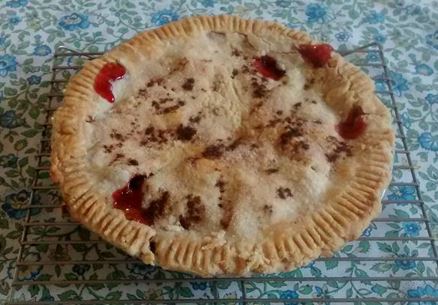
I picked wild blackberries this morning and made some of them into a pie. It’s the beginning of the wild blackberry season in Madison.

Pie is a wonderful part of Americana. For me, it is the all American dessert. When it’s good, it’s very, very good, and when it’s bad, it’s horrid. I make very good pie. Many grocery stores make very bad pie. Grocery store pies often have mass produced crusts that are not flaky and taste like straw. Since I believe that pies are more than fillings stuffed between soft cement crusts, I prefer to eat pies that I make.

My great aunt Lina used to make pie crust that was like hard cement; she mixed it too much. Needless to say, she didn’t teach me how to make pies. My mother did give a few pointers, although I actually never saw her make a pie. She gave me an important bit of advice, which I have followed with good results. She said not to mix the dough very much. My pie crust is flaky and delicious. Thanks, Mother.

My blackberry pie recipe is derived from my big fat falling-apart Better Homes & Gardens New Cook Book, 1953 edition, for the crust, and adapted from a pie recipe on the box of Minute Tapioca, for the filling. The tapioca box doesn’t say how to make blackberry pie. It says how to make blueberry pie. Close enough. Since my cooking interest is in how to cook for one or two people, I cut the tapioca box recipe in half to make an eight-inch pie. If your kitchen does not have an eight-inch pie plate, you are likely to find one at a thrift store. Ditto for rolling pin.

Blackberry Pie – one eight-inch pie
Preheat oven to 400 degrees.

2 cups fresh blackberries
½ cup sugar
2 tablespoons quick cooking tapioca

Mix fruit, tapioca and sugar in bowl. Let stand 15 minutes. Make an 8-inch pie crust while waiting. Use your recipe or the one here.

1 ½ cups all purpose flour (of course I think it is bad for us, but it makes good pie)
½ teaspoon salt
½ cup lard, butter or shortening; I use lard (I’ll have more to say about this later)
4 tablespoons cold water (approximately)

Stir together the flour and salt. Cut in the lard or other fat until pieces are the size of peas.  Sprinkle water, a tablespoon at a time, over the mixture. Gently mix with fork until all is moistened. Don’t mix too much. Form the mixture into a ball. Divide it in half. Flatten the first half slightly and roll it on a lightly floured pastry cloth or floured sheet of waxed paper. Roll the dough with light strokes, from center of the piece to the edges, so it makes a circle of dough about the size of the pie plate. Put the dough into the pie dish. I fold half over the other half, pick it up carefully and put it in the dish, and then unfold it.

Put berry/tapioca mixture into the pie plate on the bottom crust. Dot it with butter.  Moisten the peripheral edges of the bottom crust with water, all the way around. Roll the second half of the crust dough into a circle that will fit onto the pie plate. Seal the edges with fork or Fluting. I use a fork. Consult your cookbook to flute edges. Cut vent holes in crust with fork.  Bake the pie in a pre-heated oven at 400 degrees, for 45 or more minutes, until it is brown and done. If juices escape and drip onto your oven floor during baking, resign yourself. It’s still a good pie. You can put a cookie sheet under the pie dish to catch juices. I baked my pie in the toaster oven, so that option was not available.


Comment about fat:  fat is a big issue these days, but pie requires it. I think lard makes wonderful crust, but good lard is hard to find. The lard in the big box grocery stores is partly hydrogenated and not recommended unless you don’t care about your health. I can buy pasture raised, minimally processed local lard, frozen, at the Willy Street Coop (Madison and Middleton), which is the only place I have seen it. Lard contains cholesterol.  I don’t believe that cholesterol is bad for people, but that is another story. If good lard is not available, I recommend butter. A third choice is vegetable shortening, preferably not hydrogenated, although it does not lend flavor to the crust the way lard and butter do.  Purchased pie crust is available in grocery stores, and it is all right, but in my opinion, it lacks the character of homemade crust. I don’t know what extra ingredients are in it, such as chemicals and flavorings.

Thursday, July 13, 2017

Two Kinds of People in the World

There’s Two Kinds of People in the World...
This is a guest blog post by my daughter.
At the library today, we were talking about one parent’s reaction to a book whose presence in school and public libraries is frequently challenged. Banning/challenging books is one of those behaviors that gets me thinking about human nature. There are as many different ways to split us up into two camps as there are people to split up, but this one has been much on my mind lately.
When something makes people uncomfortable, they either examine their reaction or they push the irritant away. ‘Why does this make me uncomfortable’ vs ‘I don’t like it make it go away.’ This isn’t just about art, of course, it happens with any sort of idea and in many different contexts. Another version, one which is on display all over our public discourse at the moment, goes like this: when presented with information that challenges their world view, some people will re-examine their world view in light of the new information, and some will reject, deny, or attempt to discredit the new information.
People in the first group tend to respond to people in the second group by throwing more facts at them, and then fail to understand why that doesn’t change their minds. When people are clinging to a belief, opinion, position, whatever, in defiance of the facts, more facts are only going to make them more defensive. Being able to ‘prove’ that they’re ‘wrong’ doesn’t prove anything to them except that the person with the ‘proof’ is their enemy and must be stopped, condemned, ridiculed, or ignored.
We’ve all experienced cognitive dissonance. You learn something that contradicts something you’ve already incorporated into your version of reality. To pull a handy example or two from my own life: you find out that your spouse is lying to you, systematically and habitually. I willfully looked away and pretended not to know, because I could not handle the implications, and it took several years to fully integrate that truth into what I thought I had known about my marriage. Another: you find out someone you like, admire, consider a friend, is abusing his/her partner/spouse. This has happened to me a couple of times, and I understand why some people just withdraw from situations like that rather than give the abused person the support they need. I don’t condone it, but I understand. It’s hard to face and accept the fact that someone who has always seemed like a decent person can be false and cruel.
It’s hard to accept that things you believe to be true might not be, and people that you believed were going to do the right thing, aren’t. It’s easier for some people to pretend that whoever is challenging their belief is wrong, malicious, or misguided. Sometimes, even when the truth is right in front of you, it’s easier to look away.
Here’s the thing - most of us spend time in both camps. Most of us can be flexible and adaptable about some things, and blindly rigid about others. Perhaps when we’re dealing with someone who is on the opposite side of this divide from us, it might behoove us to remember the times when we were being that way, ourselves -- if we’re actually interested in bridging the divide rather than just satisfying ourselves that we’re right and they’re irrelevant. Trying to shout each other down is getting us nowhere, and ignoring the other side until they go away isn’t much of a strategy, either. I’m not saying that those reactions aren’t justified - I don’t care if they’re justified. I care if they’re effective.
If something makes you uncomfortable, sometimes you just have to learn to live with discomfort. Some cognitive dissonances don’t ever resolve. Some people are nice to their friends and assholes to their family. Some ideas are scary. Some works of art are disturbing. Some arguments can’t be won, at least not by arguing.

Sunday, July 2, 2017

Washington Island Forum 2017

“Remember matrix,” John Dominic Crossan told an audience of more than two hundred people at the Washington Island Forum that ended Friday. Matrix, he said, is the key to the consequence and punishment traditions in the Hebrew Bible. Matrix was one thread that went through three and a half days of lecture and discussion; another was distributive justice. The forum’s attendees comprised about ninety percent clergy representing many Christian denominations, and some laypeople including me. Crossan is professor emeritus in Religious Studies at DePaul University in Chicago.

We were given a boatload of big words during the week. Matrix, distributive justice, Deuteronomic, eschatology, and more. Matrix, the first, was defined as common sense of time and space, or what everyone else knows. He said that to know the matrix is to know what is going on throughout the Bible. Once one knows the matrix, questions become possible. The matrix he presented included tradition, vision, time and place. He began with Adam and Eve and went through eight great traditions that are likely to be more familiar to clergy than to ordinary people like me.

Crossan talked about Adam and Eve, with the question of deciding to eat from the tree of knowledge of good and evil, and pointed out another tradition, the Mesopotamian story, which gave the first couple the choice of eating from the tree of immortality and the tree of knowledge of good and evil. He said that people see the Adam and Eve story as about original sin and sex. Then he pointed out that many people stop with the first couple and sex rather than talk about Cain and Abel in Genesis 4. Cain and Abel gave us the beginning of escalatory violence, which continues in history to today. Cain and Abel were the farmer and the herder. It was the beginning of civilization, which he said wasn’t always very good.

Sabbath was shown as the crown of creation. Human beings are the result of creation, not the crown. Crossan said that females and males were created in the image of God to run the world for God as agents or stewards, with no hint about covenant, sanction, punishments and rewards. This began the consequence tradition. The Sabbath God in Torah is about distributive justice. Distributive justice is primary. Sabbath is the metronome of time; even the land and wild animals rest. Sabbath sets up the rhythm of distributive, not punitive, justice.

Non-violent resistance was another theme of the talks. Crossan talked about covenantal law with rewards and punishments as a deuteronomic idea that comes up in the Bible in many circumstances. Israel was situated between two superpowers who fought wars.

And so the story of Israel in the Hebrew Bible continued. God was the householder of the world house, with everyone getting a fair share, and their rights to enough were taken for granted. The radicality of God was contrasted with civilization, with God’s radicality affirmed and subverted repeatedly through time.

Crossan talked about prophetic and psalm traditions, which he said are repeatedly about distributive justice and group identity; Sabbath means everyone gets a fair share. Amos is about divine distributive justice; Amos said you will be destroyed if you don’t do distributive justice.
People made a mess of things, and the idea of atonement came up. Crossan talked about sacrificial atonement, to be good for fixing up your mess. He said that the idea of substitutionary sacrificial atonement is not in the New Testament. He favored participatory sacrificial atonement. Sacrifice means to make sacred. With elaboration that I am not including, he said that Jesus is about sacrificial atonement but not substitution. Without the matrix the sacrifice of Jesus makes no sense.

He pointed out that in baptism the person is dying to Roman values and born into the Christian world, dying with Christ. Grace, he said, is the free download of God’s character. He mentioned the kingdom of God as being among the people in the present, and it was to be realized through non-violent resistance.

We heard about the Book of Daniel, which switches into the eschatological tradition. Eschatology refers to the end or the last things, not the end of the world. Daniel has three empires with exponential increases in weaponry; the fifth kingdom/empire is the Kingdom of God. Rome called itself the fifth kingdom. Rome and the God kingdom were in an eschatological collision course. Rome vs the Kingdom of God was peace through victory vs peace through justice. The Kingdom of God was human-like, not beast-like. It was not armed revolt.

In the last talk Crossan talked about Jesus. He said that resurrection is all of humanity, a rising. Jesus in the Easter vision never rises alone (in art). The original vision of Easter is that the people who have been raised should be leading risen lives. The descent of Jesus into hell in the western tradition is going in the wrong direction; victory is raising up. Escalatory violence is our sin. The crucified one liberates us from death, not hell. Crossan said that there are two visions of Jesus, riding triumphantly on a donkey, and in Revelation riding on a war horse. He said that Jesus on a war horse is a failure of the Incarnation, getting there riding through blood. The Gospel Jesus is not the apocalyptic Jesus.
Crossan’s final message is if we separate justice and love, it goes wrong. Don’t separate them. Justice is the flesh of love and love is the spirit of justice.

The forum was held at Washington Island, Wisconsin, June 26-30, 2017, and was sponsored by the Wisconsin Council of Churches and Christian Century magazine. The talks were based on Crossan’s recent book, How to Read the Bible and Still Be a Christian.